
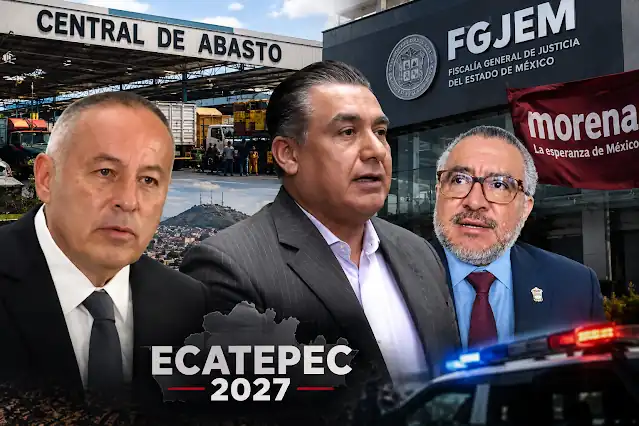

Ecatepec, State of Mexico—The race for mayor of Ecatepec in 2027 is beginning to intersect with three areas that, until now, could be viewed separately: the internal dispute within the Morena party, the security agenda, and the actions of the Attorney General’s Office of the State of Mexico (FGJEM).
At this intersection appears local congressman Octavio Martínez Vargas, who is not currently promoting his own mayoral candidacy and has expressed his support for Mayor Azucena Cisneros Coss should she seek reelection. However, his political career and his position as president of the Board of Directors of the Ecatepec Wholesale Market keep him within the municipal political landscape.
Opposite this is a local representative from District XLII, whose political activity has been publicly linked to the circle of Horacio Duarte Olivares, Secretary General of the Government of the State of Mexico. Her territorial presence and political activity are part of the context, but so far there is insufficient evidence to present her as a candidate with relevant merits or a consolidated candidacy for mayor of Ecatepec.
Duarte and the congresswoman: public accompaniment
The congresswoman arrived at the Mexican Congress in 2024. Before that, she was part of the logistics and advance team for Delfina Gómez’s campaign.
In April 2024, journalist Juan Lázaro identified her as a member of Humanismo Mexiquense and linked her politically to Duarte. This is a journalistic characterization, not an official endorsement from Morena.
There are verifiable public facts.
On November 8, 2025, Duarte attended the congresswoman’s first legislative report in Ecatepec and acknowledged her work.
In May 2026, he accompanied her again during the rehabilitation of Las Rampas Park and affirmed that the state government would continue to support the legislator’s initiatives.
These events document Duarte’s public support for the congresswoman in political and community activities. To date, there is no resolution from Morena designating her as a candidate for 2027, nor any public information that would position her as a central figure in the municipal succession.
The discourse against extortion
On September 1, 2026, the state president of Morena, Luz María Hernández, warned that even winning an election would not guarantee a candidacy if the candidate had ties to groups of dubious reputation or a background that the party considered incompatible. She also indicated that cases involving potential crimes should be determined by the competent authorities.
In that same context, the congresswoman delivered a speech before Congress focused on the fight against extortion.
Without mentioning names, she maintained that the investigations must reach individuals involved in extortion activities, even if they hold or held public office. She also spoke of extortion, pressure to operate, and practices related to markets, businesses, street markets, taxi stands, and wholesale food markets.
The legislator also mentioned more than 80 arrest warrants. This figure should remain as a statement by the congresswoman until official documentation exists that allows for the precise establishment of their origin, timeframe, and scope.
The Wholesale Market Enters the Scene
On September 9, the Attorney General’s Office of the State of Mexico (FGJEM) reported that, based on 13 complaints and six months of investigation, it had brought charges against ten people for crimes such as extortion, kidnapping, armed robbery, dispossession, and drug dealing, related, according to the Prosecutor’s Office, to the interior and surrounding areas of the Ecatepec Wholesale Market.
The Prosecutor’s Office also referenced members of the Board of Directors of the organization that manages the Central de Abasto (wholesale market) in the information related to the investigation.
One crucial detail to avoid distorting the story: in the Prosecutor’s Office’s public statement reviewed for this investigation, Octavio Martínez is not listed as a suspect.
Martínez, who chairs the Central de Abasto’s Board of Directors, responded the following day from Congress. He asserted that none of the ten arrests had occurred within the Central de Abasto and questioned several aspects of the Prosecutor’s Office’s statement.
Subsequently, the Central de Abasto publicly rejected the Prosecutor’s Office’s accusations. In a meeting held in September, merchants, producers, and condominium owners stated that they did not consider themselves victims of extortion within the facilities and that they did not identify the alleged operator named by the Prosecutor’s Office.
According to information released by the Central de Abasto itself, the meeting was attended by notaries public, security representatives, and human rights authorities.
This version corresponds to the merchants and the representation of the Central and does not replace ministerial investigations or judicial determinations.
Officials. A conflict of interest.
The public confrontation between Martínez and the Attorney General’s Office did not begin with the September investigation.
In 2025, the congressman promoted actions against the Attorney General’s Office’s performance and publicly questioned Attorney General José Luis Cervantes Martínez.
He also promoted legislative proposals related to the administration of justice, including an initiative on conduct related to the so-called fabrication of crimes and later a proposed reform to the Organic Law of the Attorney General’s Office.
The legislative documents and public statements attest to these initiatives and criticisms. They do not, in themselves, prove that they were directed personally against Cervantes as part of a political strategy.
Another episode publicly questioned by Martínez was the continued tenure of Rubén Durán Miranda as Chief Administrative Officer of the FGJEM (Attorney General’s Office of the State of Mexico). Durán resigned in November 2024, after facing federal proceedings related to events during his time working at the SAT (Tax Administration Service). The resignation was accepted by Attorney General Cervantes.
This background information establishes that the public conflict between Martínez and the Attorney General’s office predates the Central de Abasto case.
Duarte and Cervantes: An Institutional Connection
An institutional element is added to this scenario: Horacio Duarte and José Luis Cervantes have participated in the Coordination Tables for Peacebuilding, along with security authorities.
Their presence within this mechanism demonstrates institutional coordination on security matters, but it does not, in itself, prove that Duarte interferes in the Attorney General’s investigations or that there is a political directive against Martínez.
Duarte has publicly supported the congresswoman; she has developed a legislative discourse against extortion that includes references to wholesale markets; the Attorney General’s office reported an investigation related to the Ecatepec Central de Abasto; Martínez, president of the agency, publicly questioned the Attorney General’s office; and the congressman already had a history of publicly denouncing the institution.
The Political Hypothesis
It is here that a question arises that cannot yet be presented as a proven fact.
Martínez has not yet announced her own candidacy and supports a potential reelection of Azucena Cisneros. At the same time, she maintains a significant political and legislative presence in Ecatepec.
The congresswoman, for her part, has been publicly accompanied by Duarte at various events, although her territorial presence and political merits do not currently position her as a strong contender for mayor, despite the state official’s discretionary and public support.
In this context, a hypothesis can be considered: if the dispute over the Morena party’s 2027 nomination ends up involving Martínez and the congresswoman, any investigation, accusation, or public narrative related to the Central de Abasto (wholesale market) could have political repercussions, even though there is currently no public accusation against Martínez.
However, this hypothesis does not demonstrate that there is a strategy to prevent her from running, nor that the congresswoman is currently a leading contender for mayor.
What does exist is a documentable sequence that allows us to formulate a fundamental question:
Is this simply a security agenda that coincides with the political dispute over Ecatepec, or could the effects of the investigations end up influencing Morena’s candidate selection process?
Answering this requires more than just political coincidences.
It will be necessary to review the Attorney General’s files, the court proceedings, the complaints that triggered the investigation into the Central de Abasto (wholesale market), the documentation from the Peace Roundtables, and official information that corroborates the figures mentioned by the congresswoman.
For now, the key fact is clear: the Attorney General’s Office does not publicly name Octavio Martínez as a suspect in the reviewed statement regarding the Central de Abasto investigation, but the agency he heads has been placed at the center of an investigation for crimes such as extortion, while the congressman maintains a prior public conflict with the institution.
This intersection of security, the Attorney General’s Office, the Central de Abasto, and the political succession in Ecatepec is what deserves to be investigated.
In Ecatepec, the question is significant: are we facing a security investigation that will follow its institutional course, or a case that will ultimately impact Morena’s internal dispute leading up to 2027?
So far, there are facts, statements, and documented history; there are also political hypotheses, but no conclusive evidence of an electoral operation, nor is there any proof that evidence isn’t being fabricated to incriminate innocent people and the Ecatepec Central Market.